Statement by UN High Commissioner for Human Rights Michelle Bachelet
Geneva – “The past two years have demonstrated, all too painfully, the intolerable cost of soaring inequalities. Inequalities that the Universal Declaration of Human Rights, adopted by the UN General Assembly 73 years ago on 10 December 1948, sought to eradicate in its effort to pave a path to a better world.
The decades since then saw some very significant progress – gradual, uneven progress, with frequent set-backs, but definite progress nonetheless. The world as a whole grew richer, and people lived longer. More children went to school, and more women were able to gain a greater measure of autonomy. More people in more countries had more opportunities to break the shackles of poverty, class, caste and gender.
However, over the past twenty years, since 2001, a succession of global shocks have undermined that progress. And the onset of this devastating pandemic in 2020 has laid bare many of our failures to consolidate the advances we had made.
Inequalities have fuelled the pandemic, and continue to do so. In turn, the pandemic has fed a frightening rise in inequalities, leading to disproportionate transmission and death rates in the most marginalized communities, as well as contributing to soaring poverty levels, increased hunger, and plummeting living standards. These in turn risk fuelling grievances, social unrest and even full-blown conflict.
Women, low-income and informal workers, younger and older people, and those with disabilities, as well as members of ethnic, racial and religious minorities and indigenous peoples are among those hit hardest, creating even greater age, gender and racial inequalities.
Inequalities have widened both within and between countries, with most developed economies forecast to grow in 2022, while the lowest-income countries are projected to endure continued recession, pushing their people even further behind.
This divergence has been aggravated by shockingly unequal vaccine coverage – by 1 December, barely 8% of adults had received one dose of vaccine in low-income families, compared to 65% in high-income countries – and by shortfalls in social protections, which in the developed world kept many people afloat during the worst months of the crisis. In Europe, for example, according to the IMF at least 54 million jobs were supported between March and October 2020, keeping people and companies from going under. Such assistance was less available in other regions.
The environmental crisis is further exacerbating discrimination, marginalization, and inequity. A total of 389 climate-related disasters were recorded in 2020 – resulting in the deaths of more than 15,000 people, affecting 98 million others, and inflicting $171 billion in economic damage. Climate-related migration is also on the rise. Actions to address these crises are not sufficient to avert these devastating human rights consequences, with affected communities often shut out of environmental decision-making processes where their input is essential.
A growing debt crisis is also weighing heavily on many countries. Globally, over half of least-developed and low-income countries are now in, or at high risk of, debt distress. In East and Southern Africa, debt-servicing costs grew, on average, from 60 percent of GDP in 2018 to nearly 70 percent of GDP in 2021. This is due in part to sharply shrinking economic activity and falling commodities prices. The need to repay loans has already led to fiscal austerity measures that will limit the fiscal space for key investments in rights and sustainable recovery.
Austerity budgets often target health, education, infrastructure investment, and poverty reduction efforts. They disproportionally impact people in vulnerable situations – increasing inequalities that were already stark.
This is a critical period in world affairs. Humanity is reeling from the setbacks sparked by COVID-19, and struggling to make the radical changes necessary to prevent further environmental disaster.
Yet the measures needed to prevent catastrophic climate change are well-known. And, even in resource-poor environments, we have the knowledge and means to establish universal social protection measures and take the necessary actions to end discrimination, advance the rule of law and uphold human rights.
The Common Agenda set out by the UN Secretary-General in September 2021 calls for renewed solidarity between peoples and future generations; a new social contract anchored in human rights; better management of critical issues involving peace, development, health and our planet; and a revitalised multilateralism that can meet the challenges of our times.
This is an agenda of action – and an agenda of rights.
It means moving from the temporary pandemic measures to shore up health care and income protection to long-term investments in universal social protections – including universal health coverage – as well as decent housing, decent work, and access to quality education. It also means investment to bridge the digital divide.
It means decisive action to uphold climate justice and the universal human right to a healthy environment.
It means empowering people everywhere to speak up freely, and protecting civic space so that individuals can meaningfully participate in decisions that may have a dramatic impact on their lives.
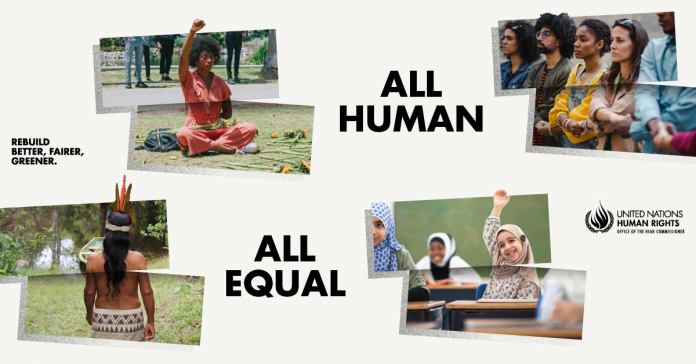
Equality is at the heart of human rights, and at the heart of the solutions required to carry us through this period of global crisis. That doesn’t mean we must all look the same, think the same or act the same.
Quite the opposite.
It means that we embrace our diversity and demand that we are all treated without any kind of discrimination.
Equality is about empathy and solidarity and about understanding that, as a common humanity, our only way forward is to work together for the common good. This was well understood during the years of rebuilding after World War II – the years that saw the development of the Universal Declaration of Human Rights and the subsequent elaboration of the all-embracing system of international human rights law. However, our failure to build back better after the financial crisis a decade ago, coupled with the social and economic turmoil caused by COVID-19 and the rapidly accelerating impacts of climate change, suggests we have forgotten the clear and proven remedies rooted in human rights and the importance of tackling inequalities. Remedies we must bring back to the forefront if we want to maintain progress – not just for those who suffer from the gross inequalities that blight our planet, but for the sake of all of us.
On this Human Rights Day, I invite everyone to join efforts to enhance equality for everyone everywhere, so that we can recover better, fairer and greener from this crisis, and rebuild societies that are more resilient and sustainable.”

GSV News Service
- GSV News Service#molongui-disabled-link

- GSV News Service#molongui-disabled-link

- GSV News Service#molongui-disabled-link

- GSV News Service#molongui-disabled-link