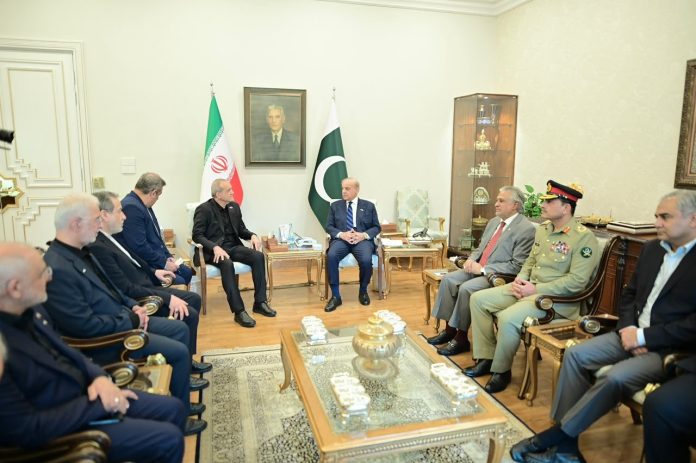
NEW DELHI – Iran has not formally withdrawn its acceptance of Pakistani mediation, but since the Mecca pact became operational, its public language towards Islamabad has hardened. Tehran has begun to question Pakistan’s role as an intermediary with Washington, Iran International reported on 9 October. Formal acceptance is not the same as trust, and the record since 5 October shows the second wearing away while the first stays on paper.
Pakistan has built a substantial standing. It secured a US-Iran ceasefire on 8 April and hosted the highest-level direct talks between the two governments since 1979 on 12 and 13 April. On 17 June, the two sides signed the Islamabad Memorandum of Understanding. Prime Minister Shehbaz Sharif said it would bring the reopening of the Strait of Hormuz by Iran and the lifting of the US naval blockade, and he credited Field Marshal Asim Munir and the help of Qatar, Saudi Arabia, Turkey and Egypt. That standing is what Tehran now has to weigh against the Mecca pact.
Implementation ran into difficulty almost at once. In July, after the United States had struck Iran and Iran had retaliated against US interests in the Gulf, Foreign Office spokesman Tahir Hussain Andrabi said implementation was facing challenges and that Pakistan would keep urging both sides to end violence and resume technical talks. In August, Interior Minister Mohsin Naqvi traveled to Tehran, where Foreign Minister Abbas Araghchi met him on two consecutive days as Pakistan sought an extension of the 60-day ceasefire under the memorandum. Pakistani government sources said Munir had also visited Tehran and invited Iranian negotiators to Islamabad to reopen talks with the United States. The mediation was already under strain before Pakistan signed in Mecca.
The Mecca pact altered the setting. Pakistan signed it on 7 August, but analysts said it and Turkey were reluctant to give up their mediating roles, and that reluctance held until 5 October, when the pact’s committee agreed in Riyadh to deploy forces to Saudi Arabia. Iranian spokesman Esmaeil Baghaei had said on 4 October that Tehran hoped reports of a Pakistani deployment for war in Yemen were untrue. After activation, Araghchi, without naming the pact, called for self-reliance and genuine brotherhood among neighbors and said such agreements would not constrain Iran. State outlets were harsher, with Tasnim reporting that Turkey and Pakistan had joined the Saudi war against the Yemeni people. Tehran’s hope of 4 October was not met, and its language changed within days.
Pakistan’s case for continuing rests on the argument that its two commitments are compatible, and it entered the mediation with its Saudi obligations declared. The first treaty with Riyadh is dated 17 September 2025. On 3 March, Foreign Minister Ishaq Dar told the Senate that he had reminded Araghchi of Pakistan’s defense obligations to the kingdom, and Araghchi, as Dar described it, responded by asking for guarantees that Saudi soil would not be used against Iran. On 2 October, Dar told reporters that he had briefed Tehran on the pact and on how Pakistan would honor it. Iran, he said, had suggested engaging the Houthis politically, an idea he called brainstorming, not a written offer, and had distanced itself from the Houthis and from Iraqi militias. Three days later, the committee agreed to deploy forces anyway. Tehran had asked for a guarantee in March and offered a political track in October, and neither shaped the outcome.
A mediator works only so long as each side believes the mediator’s obligations to the other cannot be turned into operations against it. The Mecca pact tests that belief. Javad Heiran-Nia of the Persian Gulf Studies Group in Tehran says Iran regards Pakistani participation in offensive operations against the Houthis as a red line. Defense Minister Khawaja Asif said on 5 October that only Saudi forces are fighting, with Pakistan in a supportive role that includes reconnaissance. Iran has no way to verify where that role stops, and a mediator whose limits must be taken on trust is one Tehran can no longer treat as neutral. Pakistan’s standing with Washington is also on record: President Donald Trump welcomed the pact as an example of burden-sharing in the region. Washington’s welcome of the pact leaves Pakistan, from Tehran’s view, as a partner of the other side.
The channel remains in use. Araghchi said on 9 October, Iran International reported, that Tehran had received Washington’s reply to its seven-day plan and was reviewing it. Pakistan’s Foreign Ministry told reporters in September that its mediation was continuing. A channel still in use is not a partner still trusted. Tehran keeps the line open because it needs it, not because it believes in the one who holds it.

Ashu Mann
Ashu Mann is an Associate Fellow at the Centre for Land Warfare Studies. He was awarded the Vice Chief of the Army Staff Commendation card on Army Day 2025. He is pursuing a PhD in Defense and Strategic Studies at Amity University, Noida. His research focuses include the India-China territorial dispute, great power rivalry, and Chinese foreign policy.
- Ashu Mann#molongui-disabled-link

- Ashu Mann#molongui-disabled-link

- Ashu Mann#molongui-disabled-link

- Ashu Mann#molongui-disabled-link