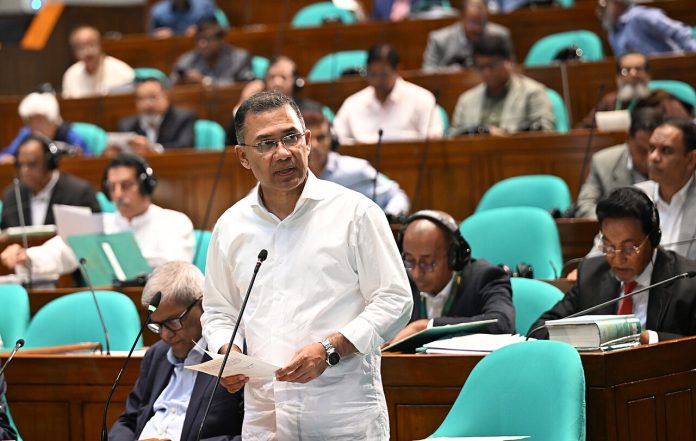
WASHINGTON – Although he ascended to power through an election whose legitimacy has been widely questioned, and with the prodding of powerful stakeholders whose interference was never in doubt, Tarique Rahman has been presiding over the unraveling of Bangladesh since the day he took the oath of office.
Return from Exile: The Rise of Tarique Rahman and the “London Group”
Tarique Rahman would have been the most unlikely person to assume power had the 2018 election been even remotely fair. However, that was not to be, and his habitual adventurism—first seen during the BNP-Jamaat coalition era from 2001 to 2006—has now fully exploded. Funded by allies in London and allegedly guided by the ISI during his long exile, Tarique appears to have pursued a course that has proven detrimental both to the BNP as a party and to Bangladesh as a nation, as it seems now.
Following his fateful departure in 2007 under an undertaking never to re-enter politics, Tarique allegedly lived a lavish life in London for over 17 years without any tangible source of income to show for it. Yet, he remained active in politics throughout his exile, maintaining direct contact with grassroots workers and activists via digital platforms.
Although his derogatory remarks regarding the Liberation War, and particularly against the founding father, drew widespread ire, his support base remained largely intact, sustained by his mother’s enduring popularity among BNP rank-and-file activists.
After the outpouring of public emotion surrounding his mother’s death shortly after his return, and following an election whose outcome felt largely predetermined, Tarique Rahman commanded immense popularity—not only among core party loyalists but also among a segment of swing voters. Following what many perceived as the most brutal and turbulent interim period under Dr. Yunus, many hoped that a seasoned political leader, backed by an established party despite its past follies and failures, would finally offer a moment of stability and hope.
Unfortunately, the warning signs were clear from the moment the first cabinet was formed. Veteran BNP leaders who had managed to sustain the party through 16 years of Awami League rule, despite numerous missteps, were largely excluded from executive power. It quickly became evident that Tarique Rahman had surrounded himself with an unqualified cohort whose primary credential was unquestionable personal loyalty. This inner circle has come to be known as the “London Group,” drawing sharp parallels to the infamous Hawa Bhaban of the past.
Health and Security Crises: Public Health Failures and Rising Violent Crime
Tarique administration’s first major salvo was the tragic surge in infant mortality from measles, a public health crisis driven by severe vaccine shortages that were willfully and criminally overlooked by the interim Yunus regime despite explicit warnings from international health bodies.
While few directly faulted Tarique Rahman for the initial outbreak, the public expected the kind of swift, decisive crisis management that had become standard under Sheikh Hasina’s tenure, when natural disasters and health emergencies were met with proactive, well-coordinated preparations.
Adding to the frustration was the sharp reversal of fortune. In previous years, Bangladesh boasted one of the highest immunization rates not just in South Asia, but in the developing world.
Regrettably, neither Tarique Rahman nor his wife, a physician by profession, has uttered a single word of empathy, let alone visited a hospital to offer comfort to the grieving parents and their suffering children.
The country’s law and order situation is in an abysmal state since the violent August of 2024, and no sign of improvement under a political government. Nationwide figures reflect a grim reality: 605 people killed, 196 abducted, 209 women raped, 294 mugged, 90 robbed, and 129 attacks carried out against police personnel. Political violence remains equally rampant, marked by 66 politically motivated killings, 61 deaths in police or jail custody, and 11 alleged extrajudicial executions. All of the above in just the first 100 days of his administration. A report was just published that during the past six months, 86 children were murdered, and 336 children were victims of sexual abuse.
Yet, there has been no dedicated task force created, nor even a word of official assurance to address the deteriorating security. It is little surprise that critics satirically view this administration as a mere extension of the interim Yunus regime, under which mob culture became a regular feature of daily life.
Economic Free Fall: Inflation, Power Outages, and Declining Investment
Meanwhile, the economy is in free fall. Inflation has surged, industries are shutting down due to acute gas shortages, and power outages—which were largely a thing of the past under Sheikh Hasina—have once again become a constant reality. Projected GDP growth is 2.2 percent when it was 6.8 percent on average during Sheikh Hasina’s 15-year rule.
Corruption now affects an estimated 82 percent of households, while overall investment has declined by 58 percent. At the same time, construction costs for every major infrastructure project initiated during the Hasina era have increased dramatically. New projects are being undertaken that many believe primarily serve to enrich powerful individuals.
Meanwhile, media houses and journalists have faced some of the worst conditions in Bangladesh’s history following the violent takeover of the administration on August 5. As a result, there is little to no media scrutiny on behalf of the public.
Political Exclusion: The Awami League Ban and Democratic Uncertainty
Amid all this uncertainty, there is a palpable sense of unease stemming from the ban on the former ruling party, the Awami League. Custodial deaths of Awami League activists have become commonplace, and extrajudicial killings appear to have become routine. Those granted bail are often rearrested at the jail gate, making a mockery of the judicial process. With millions of activists and widespread support, the ban on the Awami League remains the elephant in the room, eroding any confidence in the public psyche that the near future will bring peace.
A nation inevitably goes through periods of upheaval, but a leader must serve as a steady rudder, guiding it through turbulent times. Over the past six months, it has unfortunately become evident that Tarique Rahman lacks the qualities needed to inspire even a minimal level of confidence in his ability, either now or in the near future, to lead Bangladesh out of the quagmire it has faced since August 2024.
His statements are often incomplete and difficult to understand, creating a sense of distance between him and the people he seeks to lead. Many have begun to believe that he is lost within the complexities of the corridor of power.
Now that Bangladesh finds itself caught in a geopolitical tussle among rival powers, its strategic location appears more a curse than a blessing in these uncertain times. The Tarique regime, in this context, resembles the Mensheviks of Bangladesh, standing on precarious ground as winds of change gather strength—pushing the nation toward a future that only fate can determine.

Rana Hassan Mahmud
Rana Hassan Mahmud is Executive Director, Center for USA-Bangladesh Relations.
- Rana Hassan Mahmud#molongui-disabled-link

- Rana Hassan Mahmud#molongui-disabled-link

- Rana Hassan Mahmud#molongui-disabled-link

- Rana Hassan Mahmud#molongui-disabled-link