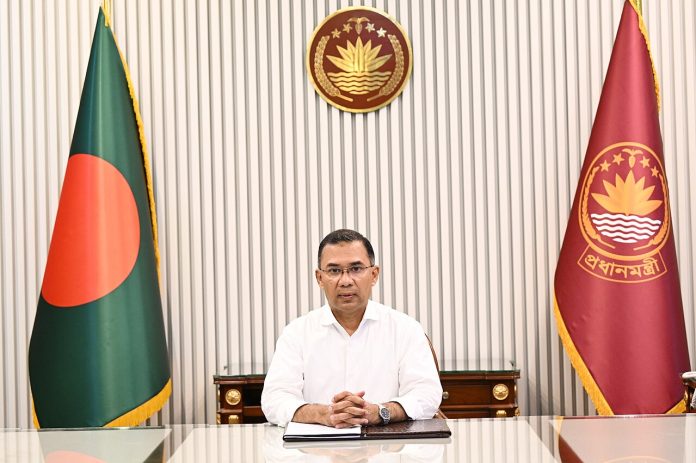
WASHINGTON – With a past marred by allegations of crime and controversy, many had expected that, after 17 years in exile in London, Tarique Rahman—now the newly elected Prime Minister of Bangladesh—would return to politics with the maturity and restraint needed to govern a fractured nation. Yet, his return has not fulfilled these hopes. Instead, his early decisions, especially the controversial banning of the Awami League, indicate that the tendencies that defined his turbulent earlier career still shape his leadership, exposing a paradox at the heart of his rule and raising urgent questions about the future of Bangladesh’s democracy.
Yet, the paradox of Tarique Rahman lies in the striking continuity between his past and present. His long absence seems to have brought little introspection or invigoration.
Before the election, his rhetoric was of democracy, transparency, and rule of law; after assuming power, his actions suggest a return to familiar patterns of expediency and reprisal. In the process, Bangladesh’s long struggle for stable governance appears to have entered another cycle of confrontation and institutional frailty.
He pledged to uphold the rule of law, yet his post-election actions tell a different story. The reshuffling of officials within the International Crimes Tribunal (ICT) without dismantling it shows that he wants to put his political rivals under pressure at the cost of institutional rupture.
The ICT, originally established through constitutional processes to prosecute those responsible for the atrocities of the 1971 Liberation War, now risks being reduced to a political instrument.
At a time when law and order remain fragile, the economy is strained following the departure of Sheikh Hasina, and citizens seek stability over confrontation, the government’s focus appears misplaced.
Rather than focusing on national recovery, Tarique Rahman appears to prioritize settling old political scores. The arrests of individuals—including retired military officials—allegedly linked to past political upheavals involving the party (BNP) he leads signal a continuation of political vendetta over constructive governance.
History offers further context to this paradox. During the tenure (2001-2006) of his mother, Khaleda Zia, when a parallel power structure was widely alleged to exist, Tarique Rahman was seen as a central figure operating alongside key elements of Jamaat-e-Islami and other radical Islamist entities in that structure.
His name has repeatedly surfaced in connection with major controversies, including the 2004 Dhaka grenade attack—a blood-soaked political mayhem that targeted the key leadership of the Awami League for annihilation, including the then opposition leader Sheikh Hasina.
Additionally, allegations have persisted regarding his involvement in arms smuggling operations through Bangladesh, reportedly aimed at fueling insurgency in India’s northeastern region.
These claims, whether fully substantiated or not, have long shaped regional security perceptions. Needless to mention, it was during the last BNP-Jamat regime that Aiman al-Zawahiri, second in command of Al-Qaeda, visited Bangladesh twice in 2002 as reported by Alex Perry of Time Magazine. Tareq Rahman’s alleged friendship with Daud Ibrahim, an underworld kingpin of India, was also known.
In this context, the trust and engagement extended to him by India may prove to be strategically complex, if not counterproductive. Any miscalculation could have implications not only for bilateral relations but also for broader regional stability.
Amid the fragile situation, on April 8, 2026, he found himself leading the process of banning the largest and oldest political party, the Awami League, by paving the way in parliament for an illegal ordinance issued by the previous Yunus regime.
Parliament, however weak that is, was not allowed to even hold a deliberation on the law to understand its current repercussions and future fallout.
“Because if you ban a political party today, what assurance do I have that tomorrow you will not ban me?” This is exactly what he told Time magazine, only to renege on his words in less than ninety days.
It is a paradox that he chose to ban a political party that, in modern history, is the only one whose elected representatives led an armed liberation war to a decisive victory. The only comparable case is that of the United States, whose elected representatives led a successful armed revolution; however, there were no formal political parties at that time.
According to all credible polls over the years, the Awami League has consistently commanded the support of roughly forty percent of the population. While its popularity did reach a nadir during the July–August upheaval of 2024, it rebounded strongly, largely due to the mobocracy that came to define the Yunus regime and its blatant disregard for anything resembling the rule of law.
Tareque Rahman’s decision to ban Awami League’s activities may offer him short-term relief during the honeymoon phase of his government, but over time, it is likely to prove hollow, giving way to socio-political unrest that neither his party nor his leadership, devoid of an iota of charisma, will be able to maneuver.
That is exactly why there are reasons to be concerned about his political acumen, vision for the future, and ability to contain the consequences that may arise while virulent religious extremist groups already hold sway over the power corridors of Bangladesh.
The paradox, therefore, is stark: a leader once expected to evolve beyond his past now risks being defined by it. Whether this strategy continues or changes course will significantly shape the future of Bangladesh’s democracy and its place in the region.

Rana Hassan Mahmud
Rana Hassan Mahmud is Executive Director, Center for USA-Bangladesh Relations.
- Rana Hassan Mahmud#molongui-disabled-link

- Rana Hassan Mahmud#molongui-disabled-link

- Rana Hassan Mahmud#molongui-disabled-link

- Rana Hassan Mahmud#molongui-disabled-link