Because of its unique national security challenges, Israel has a long history of developing highly effective, state-of-the-art defense technologies and capabilities. A prime example of Israeli military strength is the Iron Dome air defense system, which has been widely touted as the world’s best defense against missiles and rockets.
However, on Oct. 7, 2023, Israel was caught off guard by a very large-scale missile attack by the Gaza-based Palestinian militant group Hamas. The group fired several thousand missiles at a number of targets across Israel, according to reports. While exact details are not available, it is clear that a significant number of the Hamas missiles penetrated the Israeli defenses, inflicting extensive damage and casualties.
I am an aerospace engineer who studies space and defense systems. There is a simple reason the Israeli defense strategy was not fully effective against the Hamas attack. To understand why, you first need to understand the basics of air defense systems.
Air defense: detect, decide, disable
An air defense system consists of three key components. First, there are radars to detect, identify and track incoming missiles. The range of these radars varies. Iron Dome’s radar is effective over distances of 2.5 to 43.5 miles (4 to 70 km), according to its manufacturer Raytheon. Once an object has been detected by the radar, it must be assessed to determine whether it is a threat. Information such as direction and speed are used to make this determination.
If an object is confirmed as a threat, Iron Dome operators continue to track the object by radar. Missile speeds vary considerably, but assuming a representative speed of 3,280 feet per second (1 km/s), the defense system has at most one minute to respond to an attack.
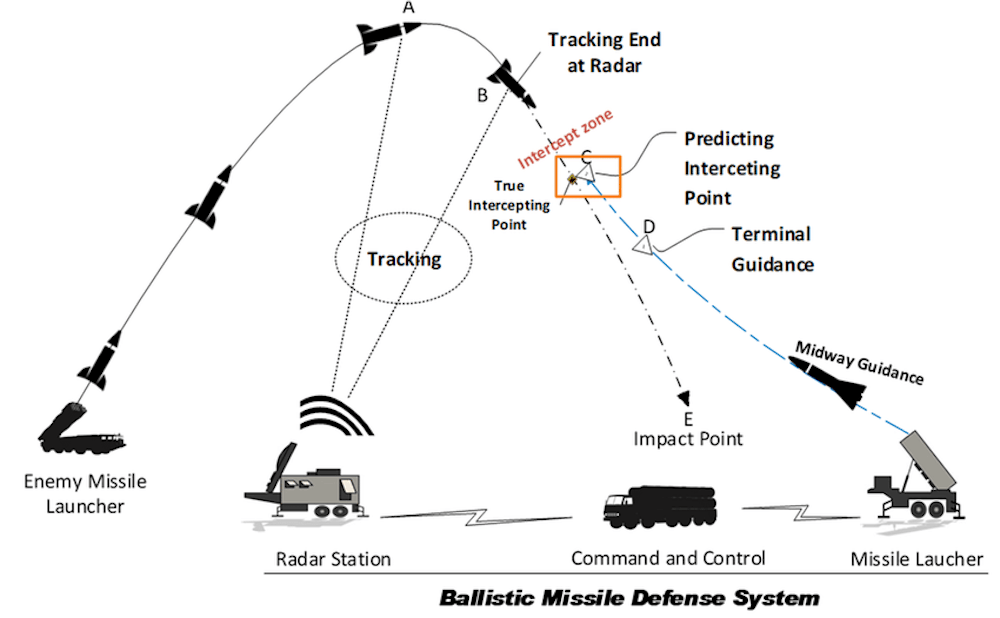
Nguyen, Dang-An et al., CC BY-NC
The second major element of an air defense system is the battle control center. This component determines the appropriate way to engage a confirmed threat. It uses the continually updating radar information to determine the optimal response in terms of from where to fire interceptor missiles and how many to launch against an incoming missile.
The third major component is the interceptor missile itself. For Iron Dome, it is a supersonic missile with heat-seeking sensors. These sensors provide in-flight updates to the interceptor, allowing it to steer toward and close in on the threat. The interceptor uses a proximity fuse activated by a small radar to explode close to the incoming missile so that it does not have to hit it directly to disable it.
Limits of missile defenses like the Iron Dome
Israel has at least 10 Iron Dome batteries in operation, each containing 60 to 80 interceptor missiles. Each of those missiles costs about US$60,000. In previous attacks involving smaller numbers of missiles and rockets, Iron Dome was 90% effective against a range of threats.
So, why was the system less effective against the recent Hamas attacks?
It is a simple question of numbers. Hamas fired several thousand missiles, and Israel had less than a thousand interceptors in the field ready to counter them. Even if Iron Dome was 100% effective against the incoming threats, the very large number of the Hamas missiles meant some were going to get through.
The Hamas attacks illustrate very clearly that even the best air defense systems can be overwhelmed if they are overmatched by the number of threats they have to counter.
The Israeli missile defense has been built up over many years, with high levels of financial investment. How could Hamas afford to overwhelm it? Again, it all comes down to numbers. The missiles fired by Hamas cost about $600 each, and so they are about 100 times less expensive than the Iron Dome interceptors. The total cost to Israel of firing all of its interceptors is around $48 million. If Hamas fired 5,000 missiles, the cost would be only $3 million.
Thus, in a carefully planned and executed strategy, Hamas accumulated over time a large number of relatively inexpensive missiles that it knew would overwhelm the Iron Dome defensive capabilities. Unfortunately for Israel, the Hamas attack represents a very clear example of military asymmetry: a low-cost, less-capable approach was able to defeat a more expensive, high-technology system.
Future air defense systems, including high-energy lasers
The Hamas attack will have repercussions for all of the world’s major military powers. It clearly illustrates the need for air defense systems that are much more effective in two important ways. First, there is the need for a much deeper arsenal of defensive weapons that can address very large numbers of missile threats. Second, the cost per defensive weapon needs to be reduced significantly.
This episode is likely to accelerate the development and deployment of directed energy air defense systems based on high-energy lasers and high-power microwaves. These devices are sometimes described as having an “infinite magazine,” because they have a relatively low cost per shot fired and can keep firing as long as they are supplied with electrical power. article
Iain Boyd, Director, Center for National Security Initiatives, and Professor of Aerospace Engineering Sciences, University of Colorado Boulder
This article is republished from The Conversation under a Creative Commons license.