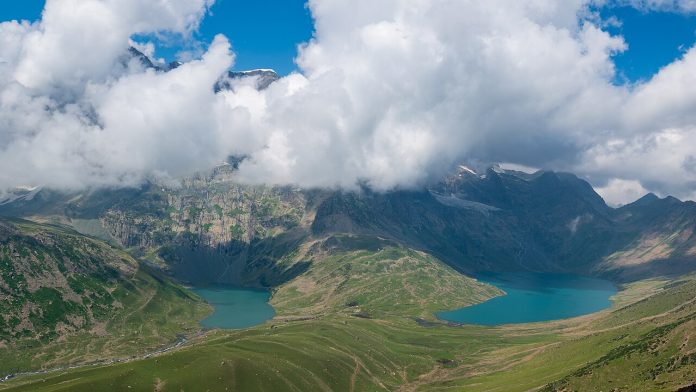
NEW DELHI – Tourism has become one of the clearest economic contrasts between Jammu and Kashmir (J&K) and Pakistan-occupied Jammu and Kashmir (PoJK). In 2024, J&K recorded 23.5 million tourist visits, more than seven times PoJK’s 3.21 million visits that year, while Gilgit-Baltistan recorded 0.89 million visits in 2025.
The difference is not simply scenic beauty. Both regions have mountains, valleys, lakes, forests, and cultural heritage. The more important difference lies in connectivity, investment, seasonal access, and the confidence of visitors and businesses to travel.
A Visitor Economy at Scale
J&K’s tourism numbers place it among India’s most visited regional economies. After 23.5 million visits in 2024, the figure declined to 17.8 million in 2025. That decline reminds us that tourism remains sensitive to security perceptions, travel advisories, and political developments.
Even with the fall, the scale remains striking. PoJK received 3.21 million tourist visits in 2024, while Gilgit-Baltistan received 0.89 million in 2025, according to the AJK and GB official statistical publications cited in the document. J&K therefore attracted roughly seven times PoJK’s 2024 footfall and nearly 20 times Gilgit-Baltistan’s 2025 footfall.
Tourism matters because it spreads income beyond government budgets. Hotels, houseboats, taxi operators, handicraft sellers, restaurants, trekking guides, ski instructors, transport businesses, and local farmers all benefit when visitor volumes rise.
Connectivity Creates Tourists
The most visible reason for J&K’s tourism advantage is access. The 272-km Udhampur–Srinagar–Baramulla railway line, completed in June 2025, links the Kashmir Valley to India’s rail network through 36 tunnels and 943 bridges, according to Business Standard and The Tribune.
The Chenab Bridge, 359 meters above the river and described as the world’s highest railway arch bridge, opened on June 6, 2025. Katra–Srinagar Vande Bharat services now reduce the journey to about three hours. For domestic tourists, this turns a difficult and weather-dependent road journey into a more predictable rail trip.
Air access reinforces the rail advantage. Srinagar airport handled 4.47 million passengers in 2024–25 and 3.38 million in 2025–26. A ₹1,667-crore expansion is planned to raise the airport’s annual passenger capacity from 2.5 million to 10 million.
By contrast, PoJK’s Muzaffarabad and Rawalakot airports have been non-operational since 2006, according to Pakistan’s Ministry of Defense, as cited through Profit. That does not make tourism impossible, but it narrows the market to road travelers and makes longer-distance or time-sensitive tourism harder to sustain.
All-Weather Access Changes the Season
Mountain tourism is often seasonal. A destination reachable only in summer loses revenue for much of the year, while one that remains accessible through winter can support hotels, transport, adventure sports, and local businesses for more months.
J&K has invested directly in addressing this constraint. The 6.5-km Z-Morh tunnel at Sonamarg, opened on January 13, 2025, keeps the area reachable in winter, while the Zojila tunnel to Ladakh is under construction.
These projects do more than shorten journeys. They extend the tourism calendar, reduce the risk of isolation during snowfall, and make high-altitude destinations viable for winter travel. For a tourism economy, that can be the difference between a seasonal income stream and a year-round industry.
Investment Follows Access
Tourism also reflects broader economic momentum. Official figures cited in the comparison put investment in J&K at about ₹18,000 crore between 2016–17 and 2025–26, compared with about ₹8,000 crore in all earlier decades, according to IANS.
That investment climate matters because visitors need more than landscapes. They need hotels, transport fleets, better roads, reliable communications, medical access, and businesses willing to expand. When private investment rises, tourism infrastructure tends to improve alongside it.
J&K’s larger public spending capacity also supports this cycle. Its 2026–27 budget is about $12 billion, roughly 11 times PoJK’s budget and about 3.7 times higher per resident, according to Greater Kashmir and The News figures cited in the document. Greater public capacity creates more scope for destination development, event promotion, road maintenance, and tourism-related public services.
PoJK’s Untapped Potential
PoJK is not without tourism assets. Its valleys, lakes, forests, and mountain landscapes could support domestic and international travel. But its tourism economy remains constrained by weak transport links and recurring instability.
The region has faced sustained cost-of-living protests since 2023, led by the Joint Awami Action Committee over electricity tariffs and flour prices. In May 2024, after violent clashes, Islamabad approved a Rs 23 billion subsidy to reduce wheat and power prices.
In October 2025, protests over elite privileges and 12 assembly seats reserved for refugees in Pakistan left at least 10 people dead amid a communications blackout, according to TBS News, citing Dawn. In 2026, authorities banned the protest group and reinstated 177 criminal cases against its members, The Express Tribune reported.
For tourism, such episodes have real effects. They disrupt travel planning, weaken traveler confidence, and make it harder for local operators to market reliability. A beautiful destination cannot realize its full economic value if visitors cannot reach it easily or trust that travel will proceed smoothly.
The Caution: Tourism Is Not Guaranteed Growth
J&K’s fall from 23.5 million tourist visits in 2024 to 17.8 million in 2025 shows that tourism cannot be treated as automatic or permanent growth. Visitor confidence can change quickly, and destinations that depend heavily on tourism need diversification.
A sustainable version of Kashmir’s tourism boom would require better waste management and carrying-capacity planning in ecologically fragile areas. It would also require ensuring that local communities receive a fair share of the benefits, rather than allowing gains to concentrate among large hotels and outside operators.
The sector would also need to broaden beyond a short peak season through winter tourism, adventure tourism, heritage tourism, and off-season travel. Continued investment in safety, roads, health facilities, and digital connectivity would be equally important, as would protection of cultural sites and natural landscapes from over-commercialization.
The Larger Point
Tourism is not merely a number in datasets. It measures whether a region can connect people, goods, capital, and opportunity. J&K’s 23.5 million visits in 2024 reflect an economy that has become easier to reach and better able to host visitors at scale.
PoJK’s far smaller visitor base does not reflect a lack of natural endowment. It reflects the compounding effect of closed airports, absent rail links, limited investment, and recurring unrest. In tourism, as in development more broadly, geography may create potential. However, connectivity and stability determine whether that potential becomes income.

Ashu Mann
Ashu Mann is an Associate Fellow at the Centre for Land Warfare Studies. He was awarded the Vice Chief of the Army Staff Commendation card on Army Day 2025. He is pursuing a PhD in Defense and Strategic Studies at Amity University, Noida. His research focuses include the India-China territorial dispute, great power rivalry, and Chinese foreign policy.
- Ashu Mann#molongui-disabled-link

- Ashu Mann#molongui-disabled-link

- Ashu Mann#molongui-disabled-link

- Ashu Mann#molongui-disabled-link