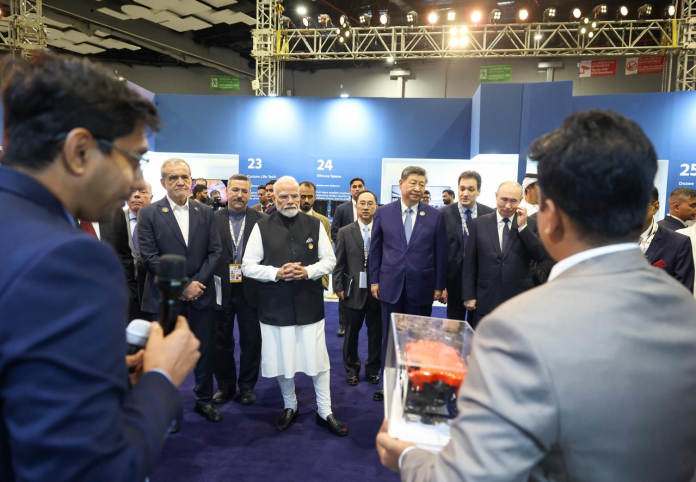
NEW DELHI – The 18th BRICS Summit in New Delhi put science, innovation, sustainability and cooperation at the centre of the grouping’s agenda. The New Delhi Declaration reaffirmed science, technology and innovation as drivers of sustainable development and welcomed deeper cooperation in research, knowledge sharing and emerging technologies.
The ocean is a natural arena for such cooperation. BRICS countries have extensive coastlines, major maritime economies and significant stakes in ocean resources, shipping, climate research and marine infrastructure. Yet understanding these environments takes more than ships and satellites. Researchers increasingly need better ways to see what is happening beneath the surface.
India’s chairship has placed this need squarely on the scientific agenda. In August, Goa hosted the eighth BRICS Working Group Meeting on Ocean and Polar Science and Technology, where scientists and officials from eight member countries discussed scientific partnerships, knowledge exchange and collaborative research. The meeting followed the Chennai Declaration on BRICS science, technology and innovation, which made collaborative research, research infrastructure and knowledge sharing central to the group’s scientific work.
The Bay of Bengal as a case in point
The Bay of Bengal shows why these ambitions demand more capable underwater observation. The Krishna-Godavari Basin, off India’s eastern coast, hosts active methane seepage and extensive evidence of subsurface gas-hydrate systems. Recent studies there have used high-resolution acoustic and visual observations to examine methane-related seabed features.
One 2026 study documented near-seafloor gas-hydrate exposure at roughly 1,750 metres depth, using an autonomous underwater vehicle, multibeam bathymetry, sonar, sub-bottom profiling and optical imagery. Another examined a shallower, developing methane-seep system linked to a submarine landslide. Combining bathymetry, sub-bottom profiling, water sampling and underwater imaging, the survey sent an ROV to about 204 metres, where it recorded direct visual evidence of active bubbling at four seepage points, along with microbial mats and other seafloor features.
What makes such missions valuable is the combination of tools. Acoustic systems identify geological structures and possible gas pathways. Water samples confirm dissolved methane. Sediment cores supply geological and chemical evidence. Direct imaging then reveals how these processes actually appear on the seabed.
Where indigenous marine robotics fits
This is where indigenous marine robotics can make a difference. An ROV fitted with cameras, sonar and underwater positioning puts researchers far closer to the phenomenon they are studying. Rather than relying only on indirect measurements, scientists can inspect the seafloor, document geological features and direct sampling to specific locations.
India’s EyeROV has built this kind of capability for marine inspection and research. Its TROUT platform, for example, integrates imaging sonar, DVL/USBL positioning and multiple cameras, with functions such as auto-depth and station keeping. It also supports underwater structural inspection and non-destructive testing.
The value of such platforms reaches well beyond methane research. ROVs can support seabed mapping, biodiversity studies, environmental monitoring, underwater archaeology, search and recovery, and the inspection of scientific equipment. In each case they offer a flexible platform for direct observation and targeted data collection.
Why this matters for BRICS
BRICS has already identified joint research cruises, marine and coastal expeditions and deep-sea research as areas for cooperation, and its ocean-science framework envisages a 2025–2030 roadmap for collaboration in ocean and polar science. Better underwater observation could turn these intentions into practice: institutions could share datasets, coordinate expeditions, develop common methodologies and jointly build technologies for observing difficult marine environments.
This also fits India’s broader ocean strategy. The Deep Ocean Mission names deep-sea exploration, underwater technologies, marine biodiversity and ocean observation among its priorities, creating a growing domestic ecosystem in which research institutions and Indian technology companies can work together.
For BRICS, the goal should not simply be to go deeper, but to understand the ocean more precisely. The Bay of Bengal, with its methane seeps, gas hydrates, sedimentary systems and complex geology, is a natural laboratory, and underwater robotics can turn it into a source of high-resolution observations.
The future of ocean science will depend not only on what researchers can detect from above, but on what they can observe, measure and understand below the surface. The next generation of BRICS ocean cooperation may need better eyes underwater, and India’s emerging marine-robotics ecosystem is increasingly able to provide them.

Ashu Mann
Ashu Mann is an Associate Fellow at the Centre for Land Warfare Studies. He was awarded the Vice Chief of the Army Staff Commendation card on Army Day 2025. He is pursuing a PhD in Defense and Strategic Studies at Amity University, Noida. His research focuses include the India-China territorial dispute, great power rivalry, and Chinese foreign policy.
- Ashu Mann#molongui-disabled-link

- Ashu Mann#molongui-disabled-link

- Ashu Mann#molongui-disabled-link

- Ashu Mann#molongui-disabled-link