Diplomatic relations between the United States and Mongolia were formally established on January 27, 1987, but the agreement was not the result of a single negotiation. It emerged from decades of shifting geopolitical interests, changing Soviet policy, and persistent informal diplomacy carried forward by individuals who kept communication alive even when official channels were blocked.
The roots of U.S.-Mongolia contact go back to Mongolia’s declaration of independence from the Manchu-led Qing dynasty on December 29, 1911, three days before China’s own break from Manchu rule on January 1, 1912. After independence, the government led by Bogd Khan reached out to the United States. Although Washington did not formally recognize Mongolia, it opened a consulate in inner Mongolia to support trade and protect American interests. Samuel Sokobin, the U.S. consul assigned to Kalgan, traveled to Niislel Khuree (then the capital) and met several times with Prime Minister Dogsomyn Bodoo. Other early links included Prime Minister Jalkhanz Khutagt Sodnomyn Damdinbazar, who eagerly supported Roy Chapman Andrews’ expeditions between 1922 and 1925.
These early interactions demonstrated interest but did not create diplomatic recognition. When the Mongolian People’s Revolutionary Party, backed by Bolsheviks, took control in 1924, Mongolia moved toward socialism. Comintern influence increased suspicion toward Americans, leading to the departure of U.S. traders and closing a period of relatively open engagement. During the 1930s, U.S. policy aligned more closely with China’s Nationalist government, which continued to claim Mongolia as part of China, further limiting the possibility of direct relations.
World War II transformed Mongolia’s international position. The United States and the United Kingdom wanted the Soviet Union to enter the war against Japan, while Moscow demanded recognition of Mongolia’s independence. President Franklin D. Roosevelt sent Vice President Henry A. Wallace to Siberia and China, and Wallace visited Mongolia on July 2, 1944, becoming the first sitting U.S. vice president to do so. His positive impressions added momentum to future discussions.
At the 1945 Yalta Conference, the United States and the United Kingdom agreed in principle to Soviet demands related to Mongolia’s status, although China’s approval remained necessary. The United States accepted responsibility for influencing China to recognize Mongolia so the Soviet Union would enter the war and help defeat Japanese forces in China. China agreed to recognition after liberation from Japan and a referendum confirming Mongolian independence. After Soviet and Mongolian troops contributed to Japan’s defeat, Mongolia held a nationwide referendum on October 20, 1945 in which 100 percent of the voters supported independence, prompting China to officially recognize Mongolia as a sovereign state. These wartime decisions by the United States, the Soviet Union, and the United Kingdom helped anchor Mongolia’s independence in the international system.
Despite this progress, Cold War rivalry slowed diplomatic recognition. Beginning in 1946, Mongolia repeatedly applied for United Nations membership while continuing to seek U.S. recognition. Early attempts were blocked by opposition from the United States and China, but attitudes gradually evolved. Senator Mike Mansfield supported recognition during the 1940s and delivered a Senate speech in 1960 that helped shift debate. When Mongolia was admitted to the United Nations on October 27, 1961 after five attempts (1946, 1948, 1955, 1956, 1957), the United States abstained rather than voting against it. Through its Permanent Mission to the UN, Mongolia maintained limited trade, cultural, and scientific exchanges with Americans, keeping a minimal connection alive.
In the early 1960s, interest in recognition resurfaced. On August 2, 1961, acting U.S. chargé d’affaires Edward Freers met Mongolian ambassador S. Luvsan in Moscow and conveyed American interest in establishing relations. The issue then reached higher levels in Washington, including President John F. Kennedy’s consideration of recognition in 1962. However, pressure from Taiwan and Chinese Nationalists under Chiang Kai-shek repeatedly blocked progress, showing how regional politics constrained bilateral diplomacy.
In 1973, diplomatic relations nearly materialized. On March 29, the United States formally expressed willingness to establish ties. Mongolia responded by sending a confidential telegram on April 18 instructing its UN mission to begin negotiations, but the message was intercepted in Prague because the Soviet Union opposed the initiative. Mongolian leaders sought Moscow’s position directly. Foreign Minister L. Rinchin consulted Soviet Deputy Foreign Minister Vasily Vasilievich Kuznetsov, who said the issue required Central Committee consultation. Chairman Yumjaagiin Tsedenbal later received similar advice from Leonid Brezhnev’s circle to pause the process. Although U.S. Secretary of State Henry Kissinger declared on November 9, 1973 that recognition was in its final stage, Soviet concerns about espionage and strategic vulnerability persisted. In 1975, Foreign Minister Andrei Gromyko warned that diplomatic ties could place Mongolia in a difficult position, and negotiations stalled once again.
The breakthrough became possible only when Soviet foreign policy changed. In the mid 1980s, Mikhail Gorbachev’s reforms reduced ideological rigidity and opened space for Mongolia to pursue broader diplomacy. During a visit to Mongolia on January 23, 1986, Soviet Foreign Minister Eduard Shevardnadze stated that establishing diplomatic relations with the United States was appropriate, signaling that Moscow would no longer block the process.
Even before the Soviet position changed publicly, informal diplomacy had already begun. In 1985, while former Senator Mike Mansfield served as U.S. Ambassador to Japan, Mongolian officials approached Japan’s ambassador to Mongolia seeking mediation. Mongolian leaders remembered Mansfield’s earlier support for their country, including his role in efforts leading to UN admission in 1961. Japan’s Ambassador Ota, a close friend of Mansfield, agreed to relay Mongolia’s proposal and help initiate negotiations.
The most significant work occurred quietly in Tokyo. Ravdan Bold of the Mongolian Embassy and Dr. Alicia J. Campi, a U.S. Embassy Tokyo consular officer and scholar of Mongolian Studies, held about fifteen meetings over eighteen months outside official embassy spaces because formal diplomatic relations did not yet exist. Campi sent reports through classified State Department channels, while Bold reported through Mongolian intelligence and Ministry of Defense networks that reached the Politburo directly, illustrating how negotiations bypassed traditional diplomatic structures.
Washington tested the seriousness of talks by asking three military-related questions about Soviet troop and weapons strength along the Mongolian-Chinese border. Because the topic was highly sensitive, Mongolians were encouraged to respond using ranges rather than precise figures. Nearly a month after their last meeting, Bold delivered the responses to Campi, who relayed them to Washington. Soon afterward, the State Department moved negotiations to New York City.
At the United Nations, Ambassador Vernon Walters and First Deputy Herbert Okun represented the United States, while Ambassador Gendengiin Nyamdoo led the Mongolian side. After meeting Okun on August 28, 1986, Nyamdoo wrote privately to Deputy Foreign Minister D. Yondon urging that recognition be finalized quickly, helping accelerate internal approval. The final discussions took place in December in New York City with Walters, Nyamdoo, Okun, and Assistant Secretary of State J. Stapleton Roy. In January 1987, Mongolia’s Politburo adopted a resolution establishing diplomatic relations, and both sides agreed on January 27 as the official date.
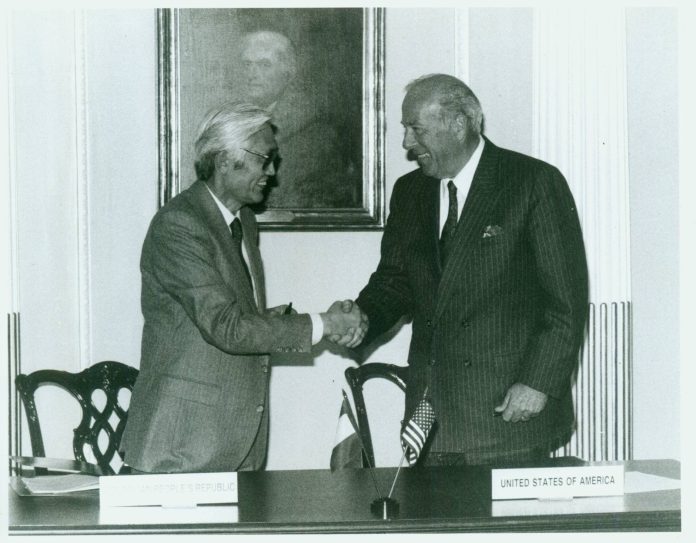
The agreement was signed in Washington, D.C., with U.S. Secretary of State George P. Shultz representing the Reagan administration and Ambassador Nyamdoo signing for Mongolia. In Tokyo, Bold and Campi marked the moment together. Bold later served as Mongolia’s Ambassador to the United States from 2003 to 2008 and held ambassadorial posts in Australia, Turkey, Azerbaijan, and Israel. Campi was posted to the U.S. Embassy in Ulaanbaatar in 1990, where she studied Mongolian at the National University of Mongolia and worked as Cultural Affairs Officer to establish the Peace Corps program

Sainkhuu Enkh-Otgon
Sainkhuu Enkh-Otgon is a healthcare professional trained in biotechnology at the Mongolian University of Life Sciences and in healthcare innovation at Johns Hopkins University. His work across Mongolia, Kenya, Uganda, and the United States has involved collaboration with clinicians, patients, government officials, and engineers, strengthening his ability to examine complex issues from technical, institutional, and community perspectives. Active in the Mongolian community in Washington, D.C., he has a longstanding interest in modern Mongolian history and U.S.-Mongolia relations. In 2023, he presented previously unpublished material on the Dilowa Khutugtu discovered in the Owen Lattimore archives at Johns Hopkins University. His article draws on documented historical sources and published scholarship, combining careful research with an international and cross-sector perspective.