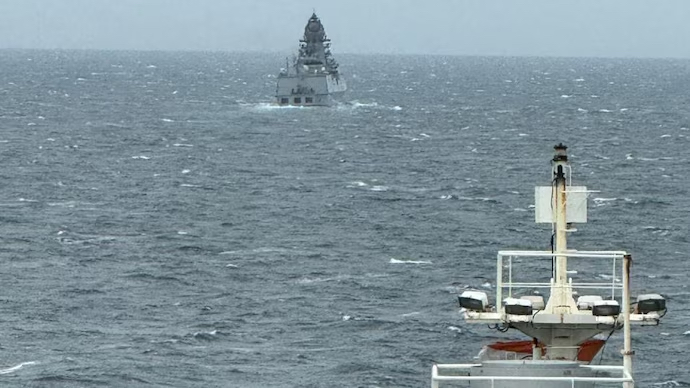
NEW DELHI – Strip away the diplomatic noise and this week’s collision sits inside a much larger story: two navies with very different operating philosophies currently sharing the same crowded stretch of ocean.
India’s posture in the wider Arabian Sea rests on a layered set of standing operations. Operation Sankalp, running for years now, keeps Indian naval assets on constant patrol through the Indian Ocean region to safeguard shipping interests and trade routes broadly, not just India’s own. Operation Urja Suraksha, launched in March 2026 amid the Strait of Hormuz crisis triggered by the Iran war, extended that umbrella specifically to escorting Indian-flagged ships and vessels bound for Indian ports through the strait. Layered on top of both is the anti-piracy and counter-hijacking activity that produced the Lila Norfolk rescue and the Somali pirate negotiation that freed 23 Pakistani sailors.
The throughline across all three is scope. India’s naval doctrine in this corridor is built around protecting shipping lanes and maritime security broadly defined, a posture that happens to also serve Indian interests but is framed, and largely executed, as regional public good.
Pakistan’s parallel effort, Operation Muhafiz-ul-Bahr (“Protector of the Sea”), launched on 9 March 2026, reads differently by design. Its stated objective is narrower and explicitly national: protecting Pakistan’s own sea lines of communication and ensuring uninterrupted energy supply flow specifically to Pakistan, amid the same regional Iran war context that prompted India’s Urja Suraksha. There is nothing wrong with a navy prioritizing its own country’s supply lines. But the operation’s own stated scope, protection of Pakistan’s SLOCs, sits in contrast with India’s broader framing, and within days of the launch, Pakistani security sources were themselves briefing journalists that the escorts should not be read as covering the Strait of Hormuz generally or ships beyond Pakistan’s own Karachi–Gulf and Karachi–Red Sea routes, reinforcing that narrower posture rather than complicating it.
Doctrine on paper is one thing. Conduct at sea is where doctrine gets tested, and this week’s collision is not a flattering data point for the “protector of the sea” framing Pakistan has given its own operation. A navy whose central maritime doctrine is literally named after protection struggled, by its own government’s later silence and India’s detailed account, to avoid ramming a foreign vessel during what the other side describes as a routine patrol.
None of this settles which navy is objectively “better” in a vacuum, a question that depends on fleet size, technology, budgets and dozens of other variables well beyond one collision. But doctrine invites comparison against conduct, and this week, the comparison did not flatter the side whose operation is named after keeping the sea safe.

Ashu Mann
Ashu Mann is an Associate Fellow at the Centre for Land Warfare Studies. He was awarded the Vice Chief of the Army Staff Commendation card on Army Day 2025. He is pursuing a PhD in Defense and Strategic Studies at Amity University, Noida. His research focuses include the India-China territorial dispute, great power rivalry, and Chinese foreign policy.
- Ashu Mann#molongui-disabled-link

- Ashu Mann#molongui-disabled-link

- Ashu Mann#molongui-disabled-link

- Ashu Mann#molongui-disabled-link