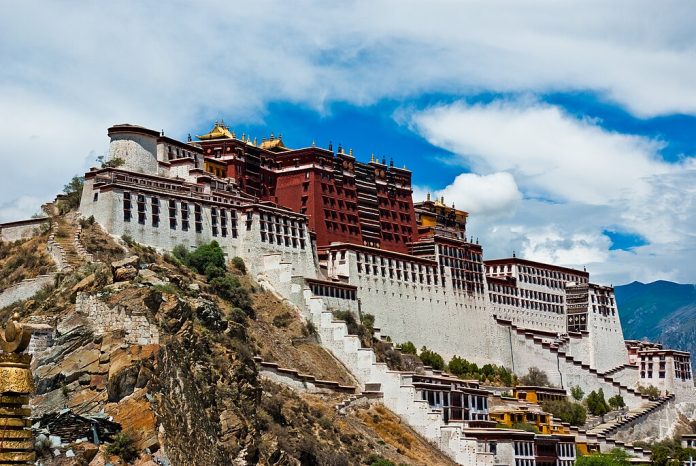
NEW DELHI – The world largely looks away. Conversations about Tibet conjure images of saffron-robed monks, snow-capped peaks, and a gentle exile in Dharamshala — a story many assume belongs to the past. It does not. Inside the Tibetan Autonomous Region and surrounding Tibetan areas today, a sophisticated, relentless system of control operates around the clock, targeting not just dissidents but ordinary people guilty of nothing more than their identity.
Patriotic Re-education: Faith as a Battleground
This systematic targeting is especially evident in Beijing’s “Patriotic Re-education” campaigns, which since the 1990s have invaded Tibet’s monasteries and nunneries. Monks and nuns are compelled to attend sessions condemning the Dalai Lama, signing loyalty pledges to the Chinese state, and denouncing Tibetan independence. Those who refuse face expulsion, detention, or worse. Monasteries operate under enforced quotas limiting the number of monks permitted to reside within them. Religious education is tightly monitored, and young children are barred from receiving formal religious instruction. The goal is unambiguous: to sever the living thread connecting Tibetan Buddhism to its practitioners, replacing spiritual allegiance with political compliance.
A Generation Burns
The consequences of these efforts to erode identity have been stark. No statistic captures the desperation of occupied Tibet more than this: Since February 2009, more than 150 Tibetans have set themselves on fire in protest— monks, nuns, farmers, and young Tibetans, including minors. Nearly all called out for the return of the Dalai Lama and Tibetan freedom before dying. China’s response has been to criminalize the act of mourning these individuals and to cut off communications in protest-affected areas to prevent images from reaching the outside world. These are not isolated incidents of personal despair. They are political statements from people who have concluded that self-immolation is the only speech left available to them.
The Digital Cage
Modern repression does not need prison walls. Tibet today is one of the most surveilled territories on Earth. A dense network of checkpoints, facial recognition cameras, and smartphone monitoring means that Tibetans’ movements and communications are subject to continuous scrutiny. GPS tracking devices are reportedly installed in vehicles. Tibetan mobile phones are subject to random searches and checkpoint inspections for banned content.
For those who wish to leave, the cage closes further: Tibetans are systematically denied passports or have existing travel documents confiscated. Unlike Han Chinese citizens, who can travel relatively freely, most Tibetans cannot visit Nepal, India, or any country where they might meet with journalists, human rights groups, or foreign governments. Silence is enforced not only by censorship but by geography made impassable.
The Panchen Lama: A Child Who Never Came Home
In May 1995, six-year-old Gedhun Choekyi Nyima was recognized by the Dalai Lama as the reincarnation of the Panchen Lama, one of Tibetan Buddhism’s most sacred figures. Within days, Chinese authorities abducted the boy and his family. He has not been seen publicly since. He would be 36 years old today. Beijing periodically claims he is living as a “normal citizen” who “wishes to protect his privacy” — a claim made without a shred of independent verification. Gedhun Choekyi Nyima has become one of the world’s most prominent unresolved cases of enforced disappearance.
A Face Forbidden
Displaying or sharing an image of the Dalai Lama is a criminal act inside Tibet. Monks have been jailed for possessing his photograph. Homes are raided to remove his image. The prohibition extends to digital space: WeChat and other platforms used by Tibetans are actively monitored for any content connected to him. In attempting to erase a face, Beijing reveals precisely how much power that face holds.
The Tibet issue is not a relic. It is a living emergency, sustained by calculated policy and enforced through fear. Every checkpoint, every loyalty session, every confiscated passport is a decision made by people, implemented by institutions, and funded by a state that counts on the world’s indifference. The least the rest of the world can offer is attention.

Ashu Mann
Ashu Mann is an Associate Fellow at the Centre for Land Warfare Studies. He was awarded the Vice Chief of the Army Staff Commendation card on Army Day 2025. He is pursuing a PhD in Defense and Strategic Studies at Amity University, Noida. His research focuses include the India-China territorial dispute, great power rivalry, and Chinese foreign policy.
- Ashu Mann#molongui-disabled-link

- Ashu Mann#molongui-disabled-link

- Ashu Mann#molongui-disabled-link

- Ashu Mann#molongui-disabled-link