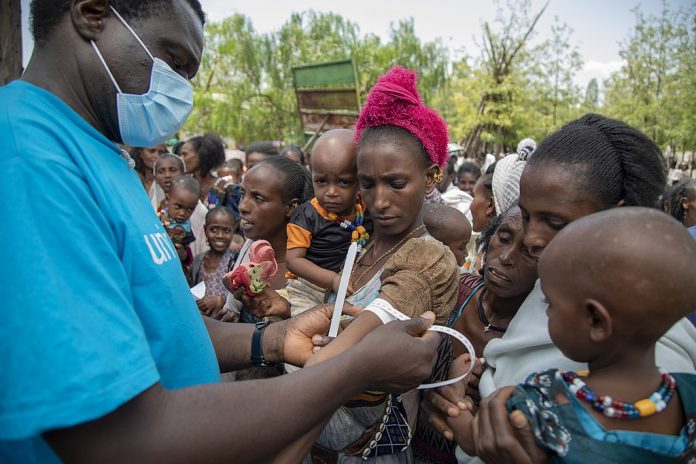
President Biden Continues Declaration of National Emergency with Respect to Ethiopia.
In a declaration extending the state of emergency concerning Ethiopia until September 2024, the Biden administration stated: “The situation in and in relation to northern Ethiopia, which has been marked by activities that threaten the peace, security, and stability of Ethiopia and the greater Horn of Africa region, continues to pose an unusual and extraordinary threat to the national security and foreign policy of the United States.”
The Abiy Regime Continues to Inflict Atrocities on the Amhara People.
On September 8, Reuters reported that Ethiopian government soldiers killed about 30 civilians in the Amhara region during house-to-house searches for militiamen. “The victims in the town of Majete included children and the elderly, and none was involved in the militia,” witnesses told Reuters.
The slaughter is the latest incident in a months-long campaign of terror inflicted by the Ethiopian government on the Amhara people. Government forces have attacked civilians with drones, and in addition to killing, have raped and stolen from innocent people. Over a thousand Amhara people have been arrested and detained on bogus charges.
The United Nations Human Rights Office reports that at least 183 people have been killed in clashes in Ethiopia’s Amhara region since July as Amhara fighters resist efforts by the federal government to disband them.
As Washington Update has previously warned, Ethiopia is nearing a tipping point. The deteriorating human rights situation, jailing and persecution of journalists, and ethnically based attacks have created conditions similar to other countries that have suffered unexpected, sudden, and violent upheavals. While some in the West cling to the image of a ruler who was awarded a Nobel Prize for peace, the reality is that Abiy is running a repressive, violent regime. He is doing nothing to counter widespread corruption or turn around heartbreaking poverty and bleak economic prospects. The government has targeted and alienated the Amhara population, antagonized Ethiopia’s neighbors, and launched a war on civil society.
Ethiopian-Americans Must Communicate with their Members of Congress.
We Ethiopians in the diaspora must inform Congress and the Biden administration about the critical situation in Ethiopia, especially about human rights abuses that are being inflicted on Amhara. American politicians will only be passionate about the critical situation in Ethiopia if they learn that Ethiopians in America are passionate about these issues.
Ethiopian-Americans need to press not only for an immediate cessation of attacks on Amhara communities but also for long-term changes that are essential to bring stability to Ethiopia and the Horn of Africa. Peace and stability depend on abandoning the ideology of ethnic division and launching a project to revise the Ethiopian constitution. The present constitution was created to exacerbate ethnic divisions. It will lead to the destruction of Ethiopia.
Murders, Abuse of Ethiopian Refugees by Saudi Border Guards.
Saudi border guards have killed hundreds of Ethiopian migrants who were attempting to cross the Yemen-Saudi border, according to Human Rights Watch. HRW also reported: “Border guards have used explosive weapons to kill many Ethiopian migrants and asylum seekers and shot others – including women and children – at close range. Survivors interviewed described scenes of horror: the bodies of women, men, and children strewn across the mountainous landscape, severely injured or already dead. A 17-year-old boy said border guards forced him and others to rape two girls after the guards had executed another migrant who refused to rape another survivor. In some instances, Saudi border guards asked survivors which limb they preferred to be shot before shooting them.”
Governments and civil society in the West must not ignore the barbaric acts of the Saudi Arabian government or allow the Saudi regime to buy legitimacy.
Report on U.S. Support for Repressive Regimes in Ethiopia.
The Chicago Council on Global Affairs has published an analysis of U.S. policy toward Ethiopia. It paints a troubling picture, showing how the U.S. supported autocratic governments and funneled economic assistance in ways that propped up the “civilian, military, and political elite dominated by the Tigrayan minority, which spurred discontent and mistrust in much of the population.”
GERD Progress.
Reuters reports that the Ethiopian government said on September 10 it had “completed the fourth and final phase of filling” of the Grand Ethiopian Renaissance Dam (GERD). This project will serve as an engine for economic development in Ethiopia.
An understanding of some basic facts is necessary to understand the situation.
Although 85 percent of the water in the Nile originates in Ethiopia, in the Blue Nile, historically, the Ethiopian people have derived very little benefit from the river. A lack of power has held back Ethiopian development, and its people have suffered from a lack of water for irrigation. Today, 83% of Ethiopians lack access to electricity; 94 percent rely on wood for daily cooking and heating. This situation is unacceptable, especially since Ethiopia possesses abundant water resources and hydropower potential, second only to the Democratic Republic of Congo in Africa. Only three percent of this potential has been developed.
The GERD will generate abundant electricity for Ethiopia and for export to its neighbors while alleviating chronic water shortages that have fueled famine.

Mesfin Mekonen
Mesfin Mekonen is the author of Washington Update, a bulletin about Ethiopia’s struggle for freedom and prosperity, and founder of MM Management.
- Mesfin Mekonen#molongui-disabled-link

- Mesfin Mekonen#molongui-disabled-link
- Mesfin Mekonen#molongui-disabled-link

- Mesfin Mekonen#molongui-disabled-link