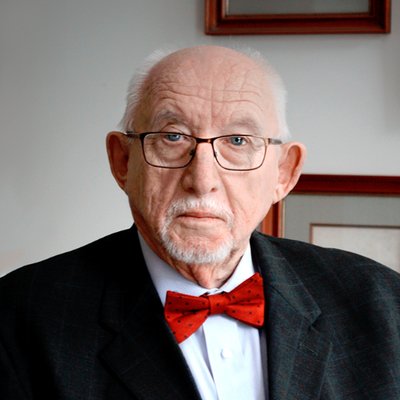

Henry Kissinger has died age 100. I remember him through his archrival, James Schlesinger.
April 24, 1980, was a bleak day for the United States. It was the day we lost helicopters and eight men in the desert during Operation Eagle Claw, the failed attempt to rescue the hostages held by Iran.
Two Washington titans were out of office, chafing at their distance from power, their inability to take action and the attendant sense of impotence. They also disliked — no, hated — each other.
These giants were Henry Kissinger and James Schlesinger. Kissinger had been a national security adviser and secretary of state. He shaped geopolitical thinking for the latter half of the 20th century. He informed foreign policy as no other has.
Schlesinger had been the chairman of the Atomic Energy Commission, director of the CIA, secretary of defense and the first secretary of energy.
I had started covering Schlesinger as a journalist when he was at the AEC in 1971, and we formed a friendship that would last until his death.
I created The Energy Daily in 1973 and later Defense Week, high-impact newsletters dominant in their fields at the time. I wanted to know what was going on with the failed rescue attempt. Although Defense Week was weekly, we frequently put out daily supplements. Along with The Energy Daily, these were hand-delivered in Washington. We got the news out fast.
I had helped Schlesinger create the Department of Energy as a sounding board and, at times, as the public voice of his frustration with the Carter administration — where Schlesinger, a Republican, didn’t always fit.
I called Schlesinger to get the story on that fateful day in the Iranian desert. He astounded me by telling me that he was in close contact with Kissinger. “Henry has better sources than I do on this,” he said.
I remember that sentence verbatim because it was extraordinary to hear Schlesinger refer to Kissinger by his first name. I had never heard it, and, except for that day when I heard Schlesinger refer to Kissinger as “Henry” all day, I never heard it again. Before and afterward, it was always just “Kissinger,” often preceded by a derogatory qualification.
“Henry may know.” “I’ll ask Henry.” “Let me see what Henry has heard.” Schlesinger had an open line to Kissinger, asking questions on my behalf all day.
I assumed that the rift between two of the most formidable figures in Washington was bridged. Some said this animosity went back to their time at Harvard.
Certainly, it reached its zenith during the Nixon administration when both men were high officeholders with considerable input into national policy.
In 1984, Kissinger published one of the volumes of his memoirs. I asked Schlesinger if he had read the book. (He seemed to read everything.) He responded with a string of invective against Kissinger. Obscenities often flowed from Schlesinger, but this was epic. So much for first names and respect that one day of entente.
When Kissinger famously told The Washington Post’s Sally Quinn at a party that he was a “secret swinger,” he wasn’t far off. Kissinger loved the social world and his place in it.
By contrast, Schlesinger entertained sparingly at his modest home in Arlington, Virginia. My wife, Linda Gasparello, and I were there frequently, and it was always takeout Chinese food and lots of Scotch.
In all the years I knew him, Schlesinger only came to my home once, although I must have gone to his scores of times — especially toward the end of his life when he liked to talk about the British Empire with me and European history with Linda.
That one visit to an apartment I had in the center of Washington wasn’t pure socializing either. The deputy editor of The Economist, the legendary Norman Macrae, was the guest of honor. Schlesinger, then secretary of energy, was keen to meet Macrae, so he and his wife, Rachel, came.
In government, Kissinger thought Schlesinger was too hardline, too reckless in his attitude toward the Soviet Union, Iran and, later, Saddam Hussein. Schlesinger thought Kissinger’s reputation was overblown and he enjoyed the machinations of negotiation without regard to the end result.
I never formally met Kissinger. But at a dinner in Washington where Kissinger had spoken and was taking questions afterward, someone at my table asked me to ask his question on the grounds that asking questions was my job.
I thought it was a stupid question, but I asked it anyway. Kissinger glowered at me, so everyone could see who had asked the question, and declared, “That is a stupid question.”
This article first appeared in White House Chronicle.

Llewellyn King
Llewellyn King is executive producer and host of "White House Chronicle" on PBS.
- Llewellyn King#molongui-disabled-link

- Llewellyn King#molongui-disabled-link

- Llewellyn King#molongui-disabled-link

- Llewellyn King#molongui-disabled-link